 In 1939, my wife’s grandfather was living in Berlin, Germany and trying desperately to do one thing. Get out. With his sister, three brothers, wife and three children. It wasn’t that he’d waited until things got really bad. Like most Jews, he’d seen the dangers that Nazi Germany posed to him and his family early on and he’d been trying to get out for years. He wrote dozens of letters to other countries, including the United States, asking for permission to come, and they all said no.
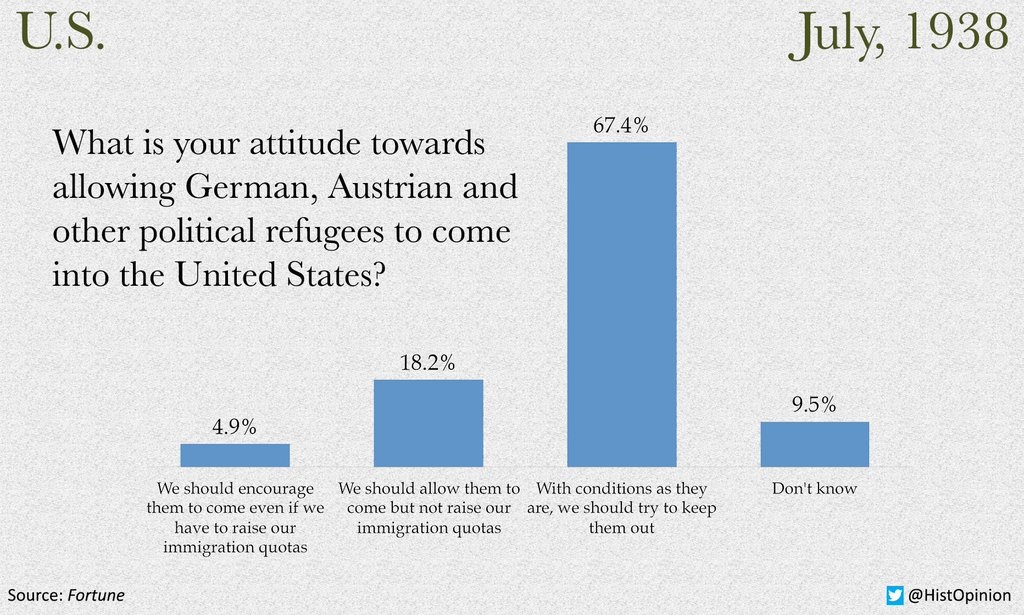
67.4% of Americans said they wanted to keep Jewish refugees out of the country in 1938.
At the time, that wasn’t unusual. Most Americans didn’t want to accept Jewish refugees from Germany because they thought Jews were Communists who would seek to control America and diminish it’s base identity as a Christian country. An American Institute of Public Opinion poll showed that nearly 70% of Americans thought the United States should actively prevent Jewish refugees from entering the country. As much as we’d like to think of our country as a beacon of hope to immigrants, Americans have traditionally feared and disparaged whatever group represented the current majority demographic seeking to enter our borders, from the Irish in the 1800s to Italians, to Eastern Europeans to Hispanics to Muslims. And all of them have been saddled with the claim that they were out to harm us in some way or another.
This decision to prevent immigrants from Muslim countries from entering the United states is only the latest example of America’s sad and misguided approach to and policy towards immigrants. It is the worst kind of fear-mongering, displaying an ignorance of historical American attitudes towards immigration, the rules that currently exist for processing and vetting visa and green card applicants, the real sources of terrorism and threats to our safety, the history and current situation of the Syrian refugee crisis, and the true profiles of immigrants from the countries affected by this ban. The irony is that it is just as counter-productive as it is inhuman.
- Yes, it fails to help alleviate the intense suffering experienced by a group of people, and in that it makes us heartless and inhuman, with all the spiritual damage that accompanies such
- In doing so it targets exactly the people who aren’t threats, while ignoring those who are. It doesn’t make us any safer, because it ignores the fact that the almost the entirety of threats to our country come from U.S. citizens, and that anyone attempting to enter the U.S. from a foreign country to perpetrate acts of violence can obtain falsified documents indicating another country of origin sufficient for travel.
- It actually empowers the very parties we claim to be trying to counter. Depriving refugees of hope of a safe escape ensures the power of dictators and terrorists by providing ready targets for their violence and recruits for their causes. It’s hard to convince the general populace of a country that they shouldn’t hate you when you won’t let them in while they are being oppressed and murdered.
- At the tech industry has already begun to observe, it deprives us of critical software engineering resources
I see lots of signs that say, “we are all immigrants,” but do we really stop to think of the pain and persecution that lay behind those immigrant stories; of the courage and vigor it takes to leave one’s home and make a journey to a strange land and the impact integrating that courage and vigor into our national character has had; and finally of the strength that our nation has gained from the times that it has overcome its inherent fear of the other and convinced itself somehow (perhaps by reading the words on the plaque of that statue in New York harbor) to be kind? That kindness is perhaps our greatest strength, and losing it to baseless fear will damage us more than we may understand.
Eventually, my wife’s grandfather did make it out of Germany, but not before one brother was killed and another sent to Auschwitz. And the country that finally let them in? Ironically, it was China.
 Happy Harricks